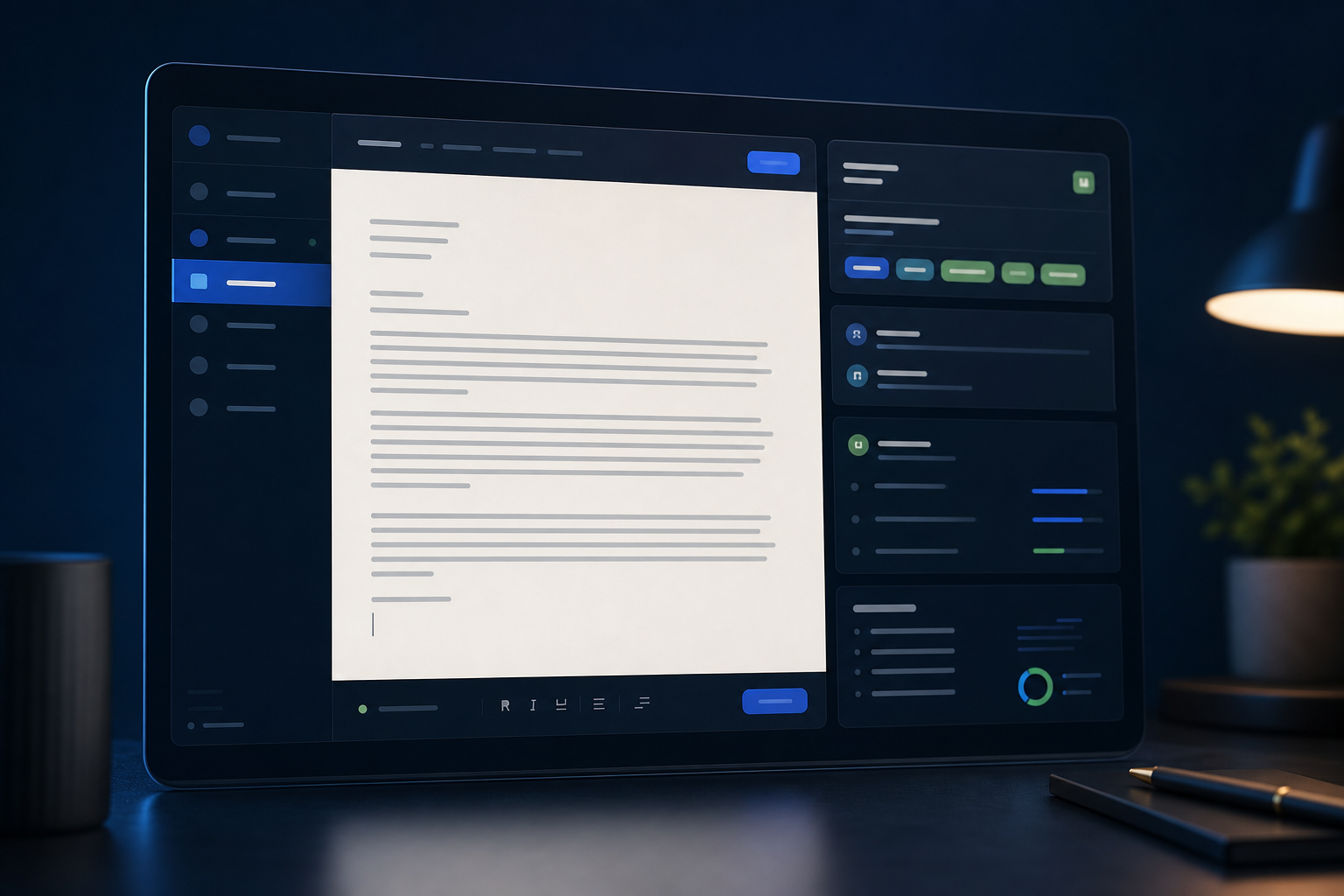
A resume records the scope of your experience. A cover letter explains why selected parts of that experience matter for this employer, in this role, now. It gives you room to connect the dots, add context that does not fit in a bullet, and show how you think about the problem the team is hiring someone to solve.
The strongest letters do not retell an entire career history. They make a short, supported argument: you understand the need, you have relevant evidence, and you are motivated to discuss the work. This guide shows you how to build that argument from research through final submission.
What a strong cover letter adds to your application
A useful cover letter is selective. Instead of summarizing every role on your resume, it identifies two or three reasons you can help this employer and supports them with concrete evidence. That makes the letter a bridge between the employer's priorities and the experience already documented in your resume.
A clear letter also shows judgment. What you choose to emphasize, how directly you address the role, and whether you can explain your impact without exaggeration all give the reader information that a list of positions cannot provide on its own.
The anatomy of a strong letter
- A header that makes your contact details and the date easy to find.
- A specific greeting and opening that name the role and establish relevance quickly.
- One or two evidence-led body paragraphs tied to the employer's stated needs.
- A concise close that confirms interest and invites a conversation.
Core principle
Your resume supplies the facts; your letter supplies the argument.
If a sentence only repeats a resume bullet without adding meaning, context, or relevance, use that space for a stronger connection instead.
Research the role and company before you write
Start with the job description, not a blank document. Mark the responsibilities that appear most often, the problems implied by those responsibilities, and the required capabilities you can genuinely demonstrate. Then review the company's own site, product pages, recent announcements, and team language for context about how the work fits the organization.
You are not looking for trivia to sprinkle into the opening. You are looking for a useful point of view: what is this team trying to accomplish, which part of your background best supports that goal, and why does this opportunity make sense as your next step?
A five-minute research brief
- Write down the role's three most important outcomes in plain language.
- Match each outcome with one truthful example from your experience.
- Note a company, product, customer, or mission detail that genuinely affects your interest.
- Choose the strongest two matches instead of trying to cover every requirement.
Research filter
Use company context only when it changes what you say.
A specific observation is valuable when it helps explain your motivation or the relevance of your evidence. Generic praise usually does neither.
Write the header, greeting, and opening hook
Keep the header conventional: your name and contact details, the date, and the recipient or company details when appropriate. If you are uploading the letter into an application form, a compact header is enough. If you are sending a formal letter or attachment, include the full business-letter details the situation calls for.
Address a named person when you can verify the right recipient. Otherwise, use a role-based greeting such as Dear Hiring Manager or Dear Product Design Hiring Team. Avoid guessing titles, honorifics, or names. Accuracy is more professional than forced personalization.
The opening should identify the position and make a relevant claim within the first few lines. Lead with a direct connection between the team's need and your background, not a dramatic anecdote or a statement that you are excited to apply.
A stronger opening formula
- Name the exact role so the application context is unmistakable.
- Lead with the capability or result most relevant to the team's priority.
- Add one sentence showing why this employer or problem is a credible fit.
Opening test
Could this opening belong only to this application?
If you can swap the company name and send the same paragraph anywhere, the hook is still too generic.
Connect evidence to the employer's needs
Use the body to prove the claim in your opening. Each paragraph should begin with a capability the employer needs, move into a short example, and end by translating that example into value for the target team. The reader should never have to guess why the story is included.
A compact STAR structure keeps examples disciplined: briefly establish the situation and task, spend most of the sentence on the action you took, and finish with the result or lesson. You rarely need every detail. Keep only what helps the employer evaluate scope, judgment, and impact.
Metrics are useful when they are accurate and meaningful, but they are not the only form of evidence. Complexity handled, time saved, quality improved, risk reduced, people supported, and decisions influenced can all demonstrate value when described precisely.
Build each body paragraph around proof
- Capability: name the skill or responsibility that matters for this role.
- Evidence: give a concise example with your action at the center.
- Outcome: state the credible result, scale, or operational improvement.
- Relevance: connect the example back to what the new team needs.
Editing rule
One developed example beats three unsupported claims.
Specific evidence gives a hiring team something to trust and something useful to ask about in an interview.
Close with a clear call to action and professional sign-off
The closing paragraph should not introduce new evidence. Summarize the fit in one sentence, confirm your interest in the work, and invite a conversation. A calm call to action such as I would welcome the opportunity to discuss how this experience could support the team is enough.
Use a professional sign-off such as Sincerely, Best regards, or Kind regards, followed by your full name. Keep the tone consistent with the rest of the letter. Confidence comes from clarity and evidence, not from claiming you are the perfect candidate.
Close in three moves
- Restate the strongest match without repeating the whole opening.
- Invite a conversation and thank the reader for their consideration.
- Use a conventional sign-off and the same name shown on your resume.
Use this practical full-letter framework
Treat the framework below as a decision guide, not fill-in-the-blank copy. Replace every bracketed idea with language grounded in the role, company, and evidence you selected during research. A finished letter should sound like one coherent argument rather than several template fragments joined together.
JobScrutiny framework
A complete letter in six purposeful blocks
Draft each block in order, then edit the transitions so the letter reads naturally from need to evidence to next step.
1. Header
Your name, phone, email, location if useful, date, and the recipient or company details appropriate to the submission format.
2. Greeting
A verified recipient name or a clear team-based greeting. Never invent a personal detail to make the letter appear researched.
3. Opening
Name the role, lead with your strongest relevant capability, and explain the specific reason this team or problem interests you.
4. Evidence
Develop one or two examples that show your actions and outcomes, then connect each example to an employer priority.
5. Closing
Reinforce the fit, express interest in discussing the role, and thank the reader without introducing a new claim.
6. Sign-off
Use a professional closing and your full name. Add a signature image only when the submission context genuinely calls for one.
Writing support
Generate a first draft, then make the judgment calls yourself.
JobScrutiny can use the role, company, job description, and an optional selected resume to create a starting point you can edit, copy, or download as text.
Tailor the content and format for every application
Tailoring does not require a completely new letter each time. Keep a library of accurate examples, then rebuild the opening, evidence order, and employer connection around the live job description. The final letter should prioritize the target role, not preserve the structure of the previous application.
Aim for one page with readable type, conventional margins, short paragraphs, and enough white space to scan comfortably. Match the visual tone of your resume when practical, but do not let styling compete with the argument. Simple formatting also transfers more reliably across application systems.
What to tailor first
- The role title, team language, and employer-specific reason in the opening.
- The order and framing of your evidence paragraphs.
- Keywords that describe real skills, tools, and responsibilities you can support.
- The recipient, company details, and file name before each submission.
Efficient workflow
Reuse evidence, not generic paragraphs.
A reliable bank of accomplishments saves time while still letting each letter make a role-specific argument.
Proofread, name the file, and submit it cleanly
Proofread once for substance and once for surface errors. On the first pass, confirm that every claim is true, the employer connection is clear, and the examples support the role. On the second, check names, job title, company spelling, dates, punctuation, and any leftover wording from another application.
If you are attaching the letter, use a clear file name such as Firstname-Lastname-Cover-Letter. Follow the employer's requested file type. If the letter is the email body, use a direct subject line, keep the greeting and sign-off, and mention any attached resume without repeating the same introduction twice.
Final submission check
- Read the letter aloud to catch long sentences and unnatural phrasing.
- Confirm the recipient, company, role, and attachment are all correct.
- Remove comments, tracked changes, placeholders, and unsupported claims.
- Send a test email to yourself when formatting or attachments are important.
Last step
Treat the submission details as part of the writing.
A strong letter loses credibility quickly when the company name, file name, or attachment is wrong.
Frequently asked questions
Use these answers to settle the format and process questions that tend to slow down an otherwise strong application.
Conclusion
A strong cover letter is a short piece of evidence-based persuasion. It shows that you understand the role, chooses the parts of your experience that matter most, and makes the connection between them easy for a hiring team to follow.
Build from the job description, develop one or two credible examples, and edit until every sentence belongs to this application. That approach produces a better letter than starting with enthusiasm and trying to add relevance afterward.

Author bio
Avery Morgan
Application Strategy Editor
Avery writes practical application guidance that helps job seekers turn relevant experience into clear, credible stories for hiring teams.
Social links